u

Bridge Fine dining,

107 Duncan Avenue, New York

914-309-7030,

Open: 09:00 am – 01:00 pm


Craft

A little about Madhubani Art

Madhubani — literally meaning “forest of honey” — is deeply embedded in the cultural memory of the Mithila region. Also known as Mithila Paintings, this art form is believed to date back over 2,500 years, with mentions in ancient texts including the Ramayana.

According to folklore, King Janaka — emperor of Mithila (spanning present-day Bihar and Nepal) and father of Goddess Sita — commissioned the women of his kingdom to adorn walls and courtyards for Sita and Rama’s wedding. What followed was the birth of an artistic tradition that remains one of India’s most enduring and sophisticated forms of folk expression.

Madhubani is defined by its two-dimensional style, bold linearity, and ornamental density. Figures appear stylized rather than realistic — with large eyes, pointed noses, and expressive features framed by double-line borders. Empty spaces are lovingly filled with cross-hatching, motifs, or fine dots, creating a rhythmic and cohesive composition.
Themes often draw from mythology, nature, and symbolic language: fish embody prosperity, peacocks represent love and desire, serpents offer protection, and the sun symbolizes the eternal source of life.

More than an art form, Madhubani is a cultural text — an intimate blend of domestic ritual and sacred storytelling. For centuries, it was not created for sale but for ceremony, inscribing myths, blessings, and community identity onto the walls of homes.

Through this collaboration, Nalom seeks to expand horizons for this ancient art and create meaningful opportunities for its practitioners — offering them an equally vibrant new dawn.

A little about Kalamkari Art

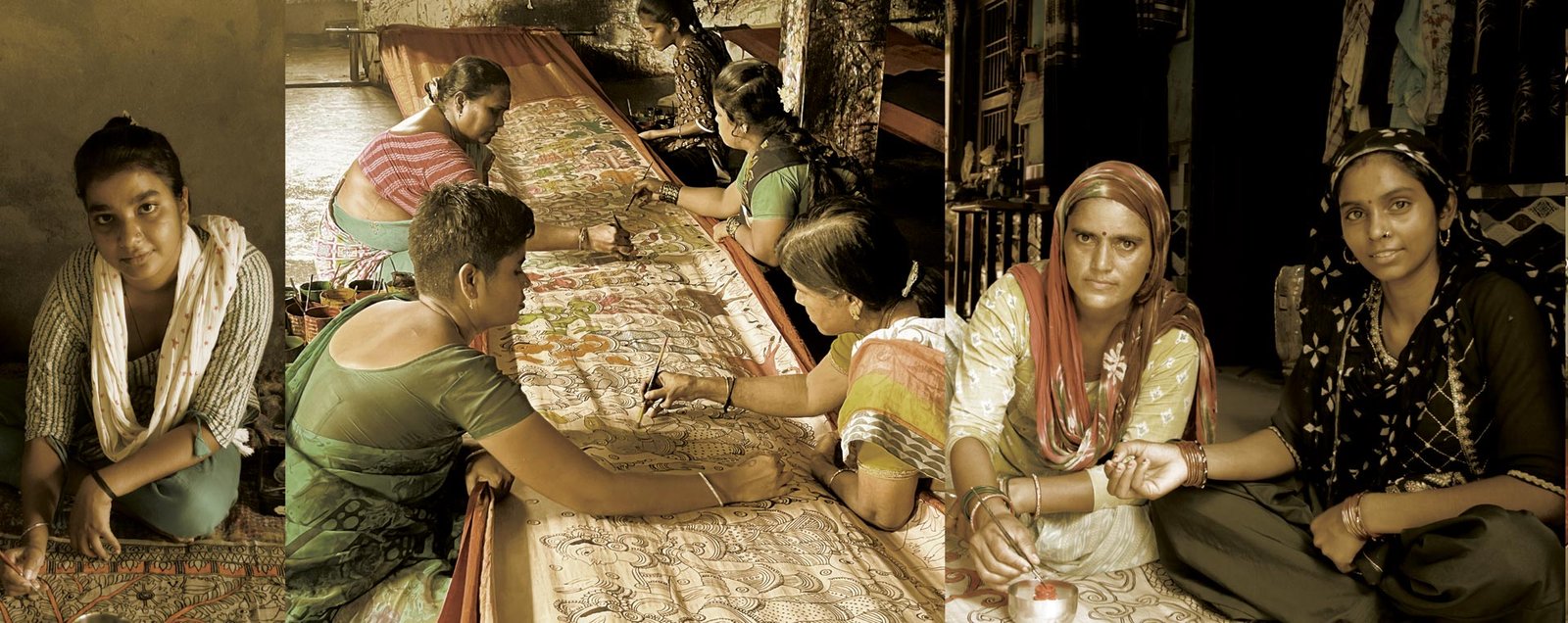
One of India’s most revered textile traditions, Kalamkari stands at the intersection of narrative art and devotional practice. The term itself comes from the Persian kalam (pen) and kari (craftsmanship), describing an art form that is meticulous, lyrical, and deeply cultural.

Kalamkari’s origins stretch back nearly two millennia, to a time when cloth became the medium for visual storytelling in South India. Long before printed manuscripts existed, artisans painted large textiles illustrating episodes from the Mahabharata, Ramayana, and Puranas — transforming fabric into narrative scrolls.

Recognized by UNESCO as an Intangible Cultural Heritage, Kalamkari remains one of the most labor-intensive textile arts, involving up to seventeen precise steps from raw cloth to finished painting. After treating the fabric with cow dung and milk to purify and prepare it for dye absorption, artisans sketch outlines using a bamboo kalam tipped with wool or fine hair. What follows is a ritual sequence of dyeing, resist-dyeing, painting, and repeated washing.

Colours are extracted from natural materials: indigo for blue, alizarin and madder for red, pomegranate rind for yellow, and iron filings fermented with jaggery for the deep blacks that shape its contours.
This slow, layered process — steeped in Vedic myth, Mughal refinement, and Persian ornamentation — gives Kalamkari its luminous, earthy palette and soulful depth.

Through its collaboration with Nalom, this heritage art finds renewed purpose and visibility. Together, we honour the custodians of this ancient visual archive and nurture the stories that have travelled through centuries.

A little about Kanchipuram silk

Every Kalamkari scarf in our collection is handwoven from pure 100% Kanchipuram silk — also known as mulberry silk — one of India’s most celebrated textiles. Originating in the temple town of Kanchipuram, this silk is prized for its lustrous sheen, durability, and rich texture, achieved through a painstaking weaving tradition passed down through generations.

Each piece is distinguished by its ornate ‘zari’ borders, woven with fine gold or silver threads. These borders hold cultural significance beyond their beauty — symbolizing prosperity, protection, and auspiciousness.
The interplay of mulberry silk and ‘zari’ creates a fabric that is both ceremonial and enduring, long cherished as a symbol of heritage, celebration, and luxury.

To wear this silk is to carry a living legacy — a textile woven with devotion, meaning, and timeless artistry.

A little about Tussar Silk

Every Madhubani scarf is created on pure Tussar silk, a fabric deeply rooted in India’s cultural and artistic heritage. Known for its textured feel and natural golden glow, Tussar is often called “wild silk” because its threads are traditionally harvested from silkworms that thrive in forest regions. Its subtly uneven, organic texture lends each piece a distinctive charm and character.

Lightweight and breathable, Tussar silk has long been a preferred canvas for India’s hand-painted art traditions. Its surface absorbs natural dyes beautifully, allowing Madhubani’s vibrant storytelling to unfold with striking clarity and depth.

In Indian tradition, Tussar represents grounded elegance — a blend of nature’s rawness and the refinement of artistry.

To own Tussar is to hold a fragment of heritage: a rare silk that becomes timeless art in the hands of master painters.